
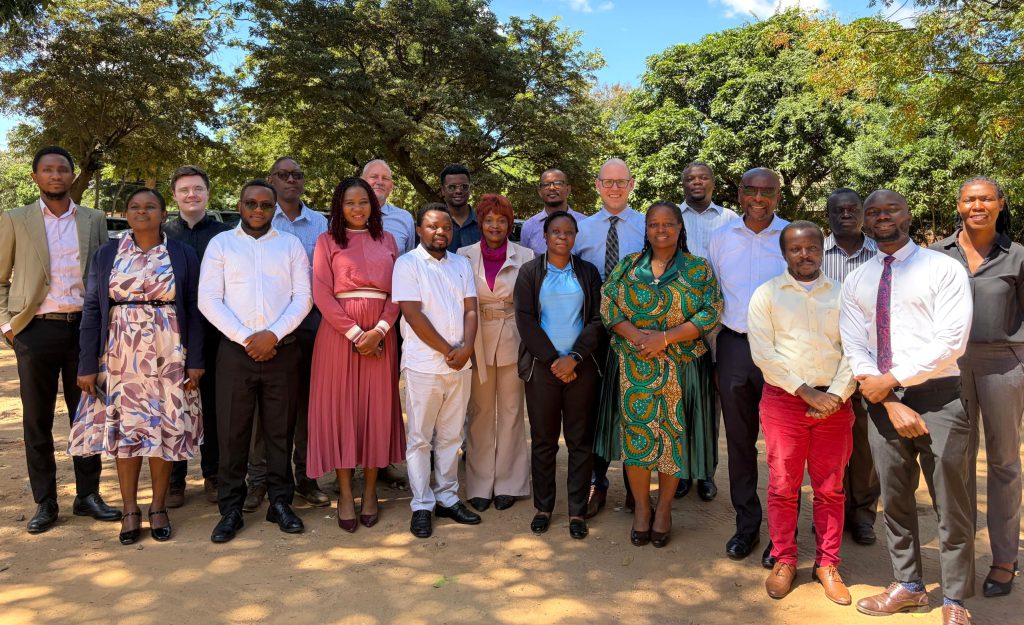
A core group for the Kuzama pa Kalondo (KpK) project which is a national research and surveillance initiative designed to modernize how Malawi monitors and responds to HIV met key stakeholders to assess the progress made in enhancing Malawi’s HIV surveillance systems.
The meeting took place on 21st April 2026 at the Public Health Institute of Malawi in Lilongwe, and it underscored the critical role of data-driven approaches in sustaining progress against HIV, particularly at a time when precise and timely information is essential to guide interventions and resource allocation.The Kuzama pa Kalondo ‘Getting smart on HIV Surveillance’ aims at strengthening HIV response and setting a benchmark for innovative, data-driven public health strategies in the region.
Addressing participants during official opening of the meeting, National AIDS Commission (NAC) CEO Dr Beatrice Matanje, noted the crucial role that this initiative is playing in reforming the HIV surveillance in Malawi. “Kuzama pa Kalondo is playing a critical role in shaping our thinking, approaches, and methods for conducting HIV surveillance in Malawi,” she said. She noted that the country is moving away from traditional survey-based approaches toward more responsive systems. “We are moving towards transforming surveillance from traditional periodic surveys to more real-time, data-driven and model-based approaches.”
Dr. Matanje further highlighted the need for integrated health surveillance, stressing that HIV programming must align with broader health systems. “HIV can no longer be addressed as a siloed programme as we are increasingly moving toward a more integrated approach,” she said. “The communities we serve do not experience health challenges in isolation, and our surveillance systems must reflect that reality.”
She assured the group that NAC remains fully committed to providing the necessary support to facilitate a coordinated process with multidisciplinary involvement to ensure that we achieve the desired outcomes.
Reaffirming the national vision, she added, “Our shared goal remains clear, to sustain the epidemic control and move decisively toward ending AIDS as a public health threat in Malawi by 2030″.

During the meeting, participants evaluated the outcomes of the stakeholder consultations and deliberations aimed at building capacity for a taskforce to establish a national HIV surveillance framework. In addition, discussions were held regarding the impact of reduced HIV testing on early diagnosis and current challenges that have implications on the 2026 HIV estimate for the country. Further, updates were provided on the research outputs and translation work being done by African Institute for Development Policy (Afidep), such as the analysis of the EMR using GHII. Further, an update was provided on the RESPOND project and postgraduate student contributions to the initiative.
The Kuzama Pa Kalondo is being implemented through a collaboration of the Kamuzu University of Health Sciences (KUHeS), Harvard T.H. Chan School of Public Health (HSPH), Nyanja Health Research Institute, African Institute for Development Policy (AFIDEP), and University of Cape Town, (UCT), in partnership with the Directorate of HIV, STIs, and Viral Hepatitis (DHA), the Public Health Institute of Malawi (PHIM), the National AIDS Council (NAC) and the US Centers for Disease Control (CDC).
Written by Chikondi Masache